Objects
Objects are the materials at the center of your Telar site — images, videos, audio recordings, documents, and other materials that your stories explore.
The Compositor provides a visual interface for managing objects — including IIIF manifest auto-fetch, image upload, and metadata editing.
Defining Objects
Every object in your site is defined as a row in your objects spreadsheet — either in the objects tab of your Google Sheet, or in objects.csv (or objetos.csv) in telar-content/spreadsheets/.
At minimum, each object needs an object_id and a title:
object_id,title
textile-001,Colonial Textile Fragment
map-lima,Map of Lima
object_id— A unique identifier (lowercase, hyphens, underscores). This becomes the object’s URL:/objects/textile-001/title— The display namealt_text— Alternative text for accessibility (optional). Falls back totitleif left empty.
Media type detection
Telar automatically determines whether an object is an image, video, or audio file based on its source — no additional configuration is needed:
- Image — A self-hosted file (JPG, PNG, etc.) in
telar-content/objects/, or an external IIIF manifest insource_url - Video — A YouTube, Vimeo, or Google Drive URL in
source_url - Audio — A self-hosted audio file (MP3, OGG, M4A) in
telar-content/objects/
For images, you have two options:
- Self-hosted: Place image files in
telar-content/objects/with filenames matching theobject_id. Telar generates IIIF tiles automatically. - External IIIF: Add a
source_urlcolumn pointing to a IIIF image URL (info.json or manifest).
For videos and audio, see Video Objects and Audio Objects.
You can add richer metadata for each object — description, creator, period, year, medium (the genre or medium of the object, e.g. “Photograph”, “Oil painting”, “Oral history”), dimensions, source, credit, and more. See the Object Columns reference for the complete column list.
The
mediumcolumn (previouslyobject_type) describes the genre or medium of the object — not the media type (Image, Video, Audio), which Telar detects automatically. The column nameobject_typestill works for backward compatibility.
Object Pages
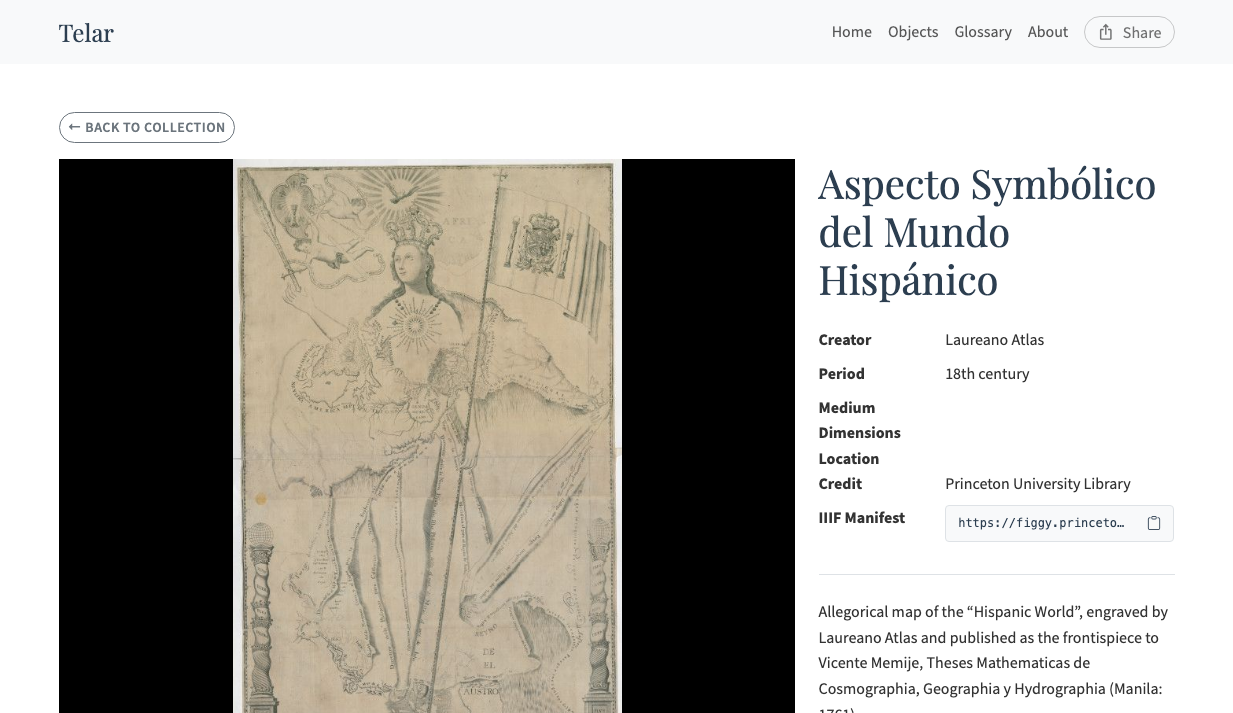
Each object gets its own page at /objects/{object_id}/. The page shows:
- A viewer — a IIIF deep-zoom viewer for images, an embedded player for videos, or an audio player for audio files
- A metadata table with all available fields (creator, period, medium, dimensions, source, credit)
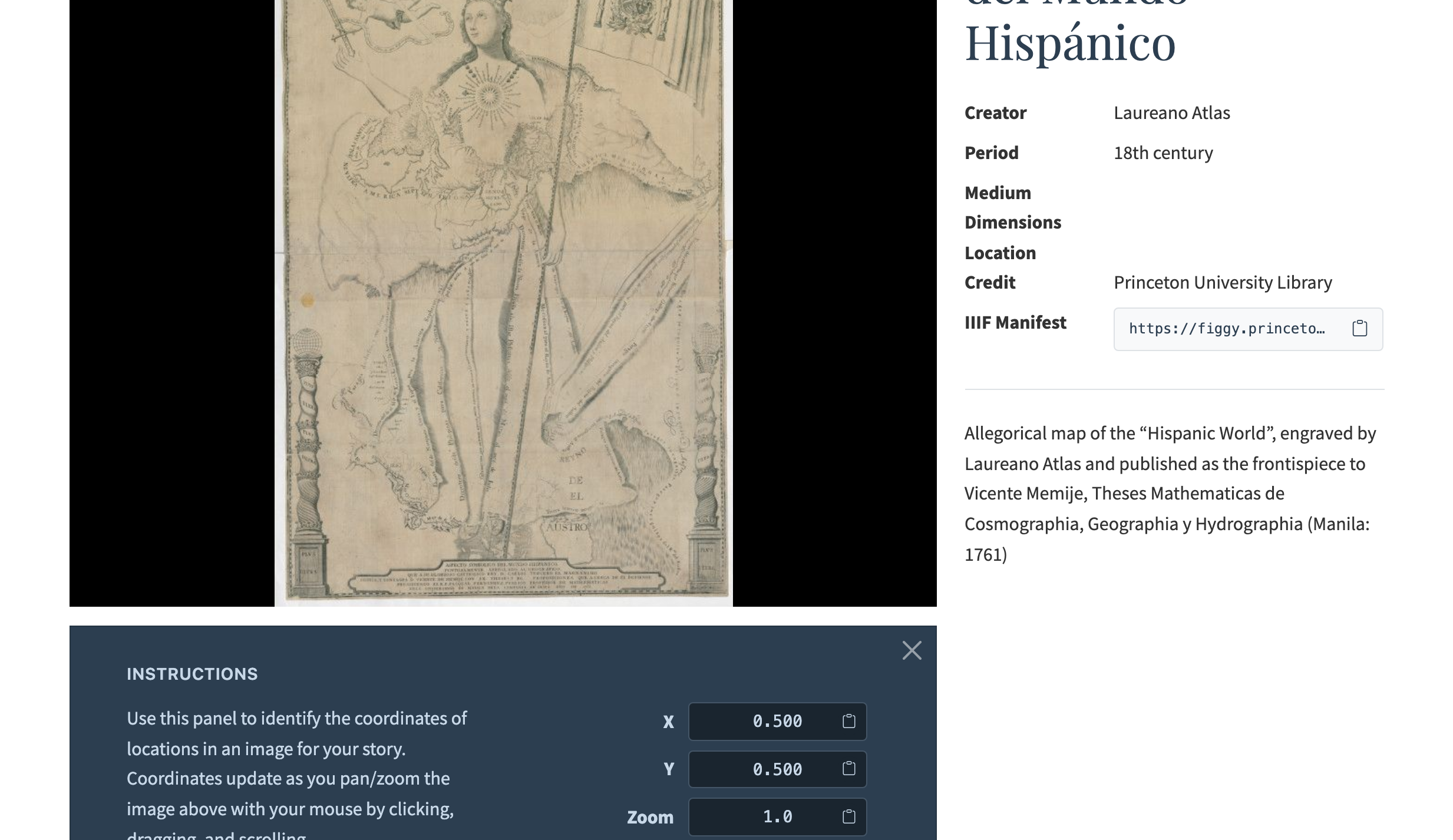
- A coordinate picker (images) or clip time picker (videos and audio) for capturing values to use in story steps
- Related stories that reference the object
- A description section if you provided one in the spreadsheet
Coordinate Picker
The coordinate picker is a development tool on each object page. Click or zoom on the image, then read the normalized coordinates (0–1 range) displayed below the viewer. Use the Copy buttons to copy coordinates directly into your story CSV.
See Also
- Objects Gallery — Browse, search, and filter your collection
- Object Columns — Complete column reference for objects.csv
- Self-Hosted Images — Upload and process your own images
- External IIIF Images — Use images from museums and libraries
- Video Objects — Adding videos from YouTube, Vimeo, and Google Drive
- Audio Objects — Adding self-hosted audio files
- Stories & Panels — How objects are used in stories